Plant Spotlight: Coontie & the Atala Butterfly
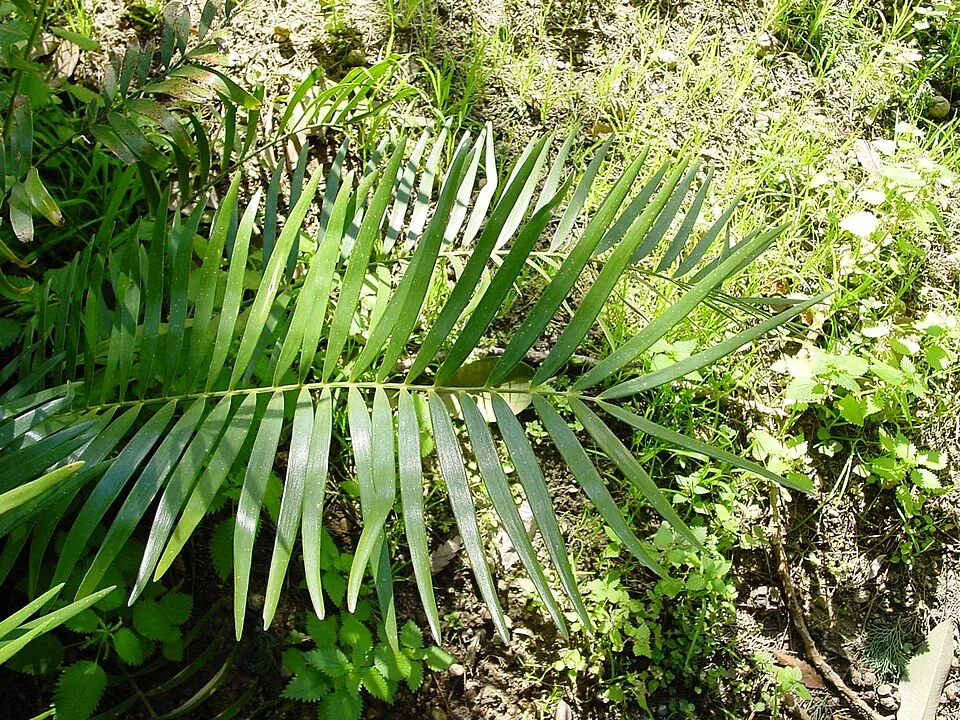
There is a plant in Florida older than the dinosaurs, or close enough that it feels that way — and there is a butterfly that nearly vanished from the earth with it, and then came back. Both of them can live in your yard in Spring Hill. This is their story.
Florida's only native cycad
Coontie (Zamia integrifolia) is a cycad, not a palm and not a fern, though it is often mistaken for both. Cycads are an ancient group of plants that flourished in the Mesozoic era, when dinosaurs walked; coontie is the only cycad native to the United States, and the only one native to Florida. It grows as a low, mounded evergreen shrub, typically 2–3 feet tall and spreading 3–5 feet wide, with stiff, glossy, feather-like fronds arching out from a thick underground stem. It is slow-growing — a plant can take years to reach its full size — and it can live for decades. Mature plants produce cones rather than flowers: the female cone carries striking bright orange-red seeds, the male cone smaller and brownish-green.
Coontie is native to sandy soils, coastal dunes, pine flatwoods, and the understory of hardwood hammocks in Central and South Florida — in other words, exactly the conditions of a Hernando County yard. UF/IFAS lists it for zones 8b–11, which covers all of Florida, and describes it as highly drought-tolerant once established, moderately salt-tolerant, and happy in full sun, part shade, or even full shade. It does not tolerate wet soil, so plant it where water drains away. It can be planted year-round in Florida, though fall planting gives it the easiest start.
Indigenous peoples of Florida — the Calusa and Seminole among them — knew coontie long before any botanist did. Its starchy underground stem could be processed into a flour, sometimes called Florida arrowroot, but only with careful preparation: the raw plant is toxic. The name “coontie” itself is generally traced to the Seminole word for the plant. That history turned tragic in the early 20th century. Coontie starch became a commercial product — used in government rations and even animal crackers during World War I — and because a coontie takes the better part of a decade to mature, harvesters dug wild plants out of their hammocks and pine rocklands rather than growing them. By the early 1930s, wild coontie had been largely wiped from the landscape.
And with the coontie went the butterfly that depended on it.
The butterfly that was thought to be extinct
The Atala butterfly (Eumaeus atala), also called the coontie hairstreak, is a small butterfly with velvety black wings, iridescent blue spots, and a bright orange-red abdomen — one of the most striking insects in Florida. It was once, in the words of one early entomologist, the “most conspicuous insect in semitropical Florida.” Then, as its only host plant disappeared, it vanished too. By the mid-1930s the Atala was nearly gone; occasional specimens turned up into the mid-1960s, and then nothing. It was believed to be extinct in Florida — so completely that when the U.S. Endangered Species Act was passed in 1973, the Atala was not even listed, because there was thought to be nothing left to protect.
Then, in 1979, naturalist and author Roger Hammer was searching for seeds on Virginia Key, a barrier island near Miami, when he noticed bright red caterpillars with yellow spots feeding on a wild coontie. He collected some, raised them, and watched them emerge as Atala butterflies — the presumed-extinct species, alive. Word spread through Florida's small conservation community, and caterpillars from that single colony were shared with botanical gardens and wild areas where coontie still grew. The Florida Museum of Natural History notes that, as far as is known, all current Atala populations originated from that one Virginia Key colony.
Today the Atala is common locally in southeast Florida — in Miami-Dade, Broward, and Palm Beach counties — and has been reported creeping north, with colonies and sightings in Brevard County, Pinellas County, Gainesville, and Tallahassee. It is still rare with a limited distribution overall, in the Florida Museum's words, and it is not state or federally listed as threatened or endangered, a quirk of having been thought extinct when the listing laws were written. The recovery is real, and it is also fragile: it rests entirely on coontie being present, in enough density, for females to find.
How the two depend on each other
The relationship is exact and exclusive. The Atala lays its eggs only on coontie (females will also use non-native ornamental cycads, but research found the larvae survive better and live longer on native coontie, and both butterflies and caterpillars overwhelmingly choose coontie when given a choice). The caterpillars feed only on coontie foliage, and they feed hard — a flush of caterpillars can strip a plant down to its stems. That is alarming to see, and it is also the deal. The caterpillars are eating the plant's toxin, cycasin, concentrated in the tender new growth, and storing it in their bodies. The toxin stays with them through the chrysalis and into the adult butterfly, and even into the eggs, making caterpillars, butterflies, and eggs distasteful and toxic to predators. A healthy, established coontie recovers by the next season. A plant stripped bare in summer is not a dead plant; it is a plant doing its job.
That is why coontie matters beyond its good looks. Planting it is not just landscaping. In South Florida it is literally rebuilding a butterfly's habitat, one yard at a time — and every coontie planted in Central Florida adds a stepping stone northward, even if Atalas themselves are still uncommon visitors in Hernando County. Be honest about that in your own garden: plant coontie because it is tough, beautiful, and native, and treat an Atala as the extraordinary bonus it would be this far north.
How to grow coontie in Zone 9B
- Sun: Full sun to full shade. It looks best with some sun, but it will grow in the shade under oaks where little else will.
- Soil and water: Well-drained sandy soil is ideal; it must not sit wet. Water regularly for the first few months after planting, then back off — established coontie is highly drought-tolerant, and overwatering will rot its underground stem.
- Size and spacing: Typically 2–3 feet tall, 3–5 feet wide at maturity. Give it room to spread, and do not plant it where you will be tempted to shear it — it has no need of pruning. Remove only dead fronds at the base if you like a tidy look.
- Cold: Hardy in zones 8b–11, so our Zone 9B winters are well within its range. A hard freeze may brown the fronds; new growth replaces them in spring.
- Care: Almost none once established. No fertilizer needed, no spraying — and never spray a coontie that has Atala caterpillars on it. Expect some chewed foliage in summer; the plant recovers.
- Safety — read this: All parts of coontie are poisonous if eaten, and the seeds are the most toxic. UF/IFAS notes that poisoning can cause vomiting, bloody diarrhea, liver failure, and in some cases death, and that as few as one or two seeds can be dangerous to a dog. Plant coontie away from where small children or pets are likely to chew on plants, teach children not to eat the bright orange seeds, and do not try to make flour from it — the traditional preparation is complex and dangerous to get wrong.
- Buying: Coontie is now widely available at native plant nurseries — a happy ending to its history of overharvesting. Look for Florida-grown plants from native nurseries or FNPS chapter sales, and check the botanical name (Zamia integrifolia; older sources may say Zamia floridana or Zamia pumila — the Atlas of Florida Plants uses Zamia integrifolia).
Plant one coontie, and you have planted a living fossil, a piece of Florida history, and — if the butterflies ever find it — a small part in one of the great comeback stories in American conservation. That is a lot to ask of a three-foot shrub. It is equal to it.
Sources: UF/IFAS Gardening Solutions, “Coontie”; UF/IFAS Extension Sarasota & Pasco Counties; Florida Museum of Natural History, Daniels Lab, “Atala butterfly”; Bok Tower Gardens, “A Butterfly Back from the Brink of Extinction” (2023); Atlas of Florida Plants. Atala chrysalises photographed on coontie: see Wikimedia Commons, File:Atala Butterfly Cocoons.jpg (AMaken, 2024, CC BY-SA).