A Pollinator Garden Plan for Zone 9B
Interactive 10×4 Bed Blueprint (Or Open Full Yard Studio)
Milkweed Tag Warning (UF/IFAS 2025)
Always verify Asclepias tuberosa (dry sand) or A. incarnata (wet spot). Invasive tropical milkweed (A. curassavica) disrupts monarch migration and spreads OE parasites.
A pollinator garden is not a flower bed with a few pretty blooms. It is a small ecosystem with two jobs: feed adult pollinators with nectar and pollen, and feed their babies with leaves. A butterfly that visits your flowers but cannot lay eggs anywhere will not stay, and a yard with host plants but no nectar will not hold adults long enough to matter. The plan below does both, in a space any suburban yard can spare, using plants proven for sandy Zone 9B soil.
The bed
Size and site: One bed, roughly 10 feet long by 4 feet deep, in full sun — six or more hours of direct sun a day. If you only have part shade, this exact plan will not work as written; you will need shade-tolerant substitutes, so pick the sunniest spot you have. A rectangle against a fence, wall, or hedge works well, because the fence gives you a vertical surface for vines and a windbreak for butterflies. Face it south or east if you can, so it warms early in the day when pollinators get moving.
Soil prep: Our sand drains fast and holds few nutrients, and that is fine — these plants evolved for it. Pull weeds, loosen the top few inches, and mulch with 2–3 inches of pine bark or pine straw, keeping mulch a few inches away from stems. Do not add heavy fertilizer. Water new plants regularly for the first 2–3 months, then taper off; most of these are drought-tolerant once established.
The layout: tall at the back, low at the front
Think of the bed as a small theater. Tall shrubs and vines at the back, medium perennials in the middle, and low groundcovers spilling over the front edge. Pollinators like edges and layers — different heights mean different flowers at different levels, and sheltered spots to rest out of the wind.
Back row (against the fence, 3–6 feet tall):
- Firebush (Hamelia patens) — 1 plant, center-back. The anchor. Red-orange tubular flowers late spring through fall; hummingbirds and butterflies visit daily. May die back in a hard freeze and return from the roots.
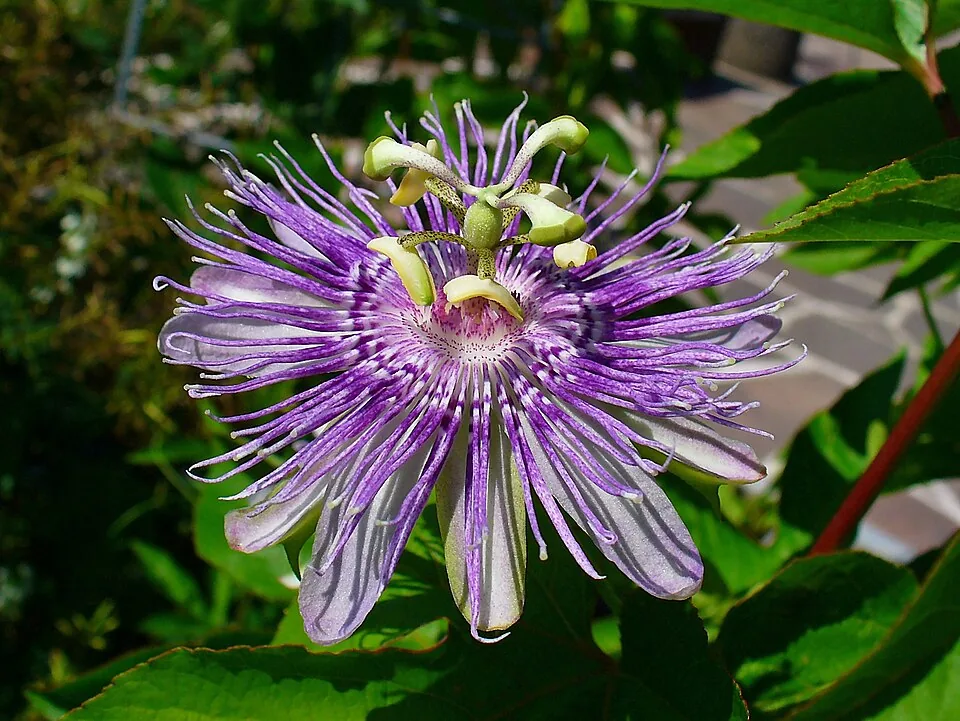
- Purple passionflower (Passiflora incarnata) — 1–2 vines trained up the fence or a trellis at one end. The larval host for the zebra longwing (Florida's state butterfly), Gulf fritillary, and Julia heliconian. Vigorous, so give it room and be ready to guide it.
- Coral honeysuckle (Lonicera sempervirens) — 1 vine on the fence at the other end. Tubular red flowers that hummingbirds love; berries feed birds later. Not to be confused with invasive Japanese honeysuckle.
Middle row (1–3 feet tall):
- Butterflyweed (Asclepias tuberosa) — 3 plants, spaced 18–24 inches apart. The native milkweed for dry sandy soil, and the monarch's host plant. Bright orange flowers in late spring and summer. Do not substitute tropical milkweed (Asclepias curassavica): UF/IFAS lists it as invasive in Florida and does not recommend it.
- Coreopsis (Coreopsis leavenworthii) — a drift of 5–7 plants. Yellow daisies spring into summer; Florida's state wildflower, easy from seed, beloved by native bees.
- Blue porterweed (Stachytarpheta jamaicensis) — 2 plants. Deep blue flower spikes that bloom over a long warm season and are a particular favorite of butterflies.
- Lanceleaf blanketflower (Gaillardia aestivalis) — 3–5 plants. A note on names: the blanketflower sold everywhere, G. pulchella, turns out not to be a Florida native at all (UF/IFAS, per Weakley 2020) — it's a fine Florida-Friendly flower, but G. aestivalis is the true native blanketflower for north and central Florida, with the same long warm-season bloom for bees and butterflies. See its flagged entry in our database.
Front row and edges (under 1 foot):
- Frogfruit (Phyla nodiflora) — let it creep along the front edge. Tiny white-and-purple flowers for small bees and butterflies, and host for common buckeye, white peacock, and Phaon crescent caterpillars.
- Sunshine mimosa (Mimosa strigillosa) — a low, spreading groundcover with pink powder-puff flowers that native bees work hard. Full sun, drought-tolerant once established; it can go thin or dormant in the coolest months.
- Coontie (Zamia integrifolia) — 1–2 plants tucked at a corner. Evergreen structure year-round, and the host for the Atala butterfly. Be honest with yourself here: Atalas are primarily a south Florida butterfly and are uncommon this far north, so plant coontie because it is a beautiful, bulletproof native — an Atala visit would be a rare bonus, not an expectation. (See our coontie spotlight.)
Bloom succession: something in flower in every season
A pollinator garden that blooms only in spring is a restaurant open one season a year. Aim for overlap, so there is never a gap:
- Late winter–spring: coral honeysuckle, coreopsis, butterflyweed coming into flower; muhly grass is quiet now but holding structure.
- Summer: firebush, porterweed, blanketflower, passionflower, and butterflyweed at full strength — the busiest season in the bed.
- Fall: firebush still going, muhly grass (Muhlenbergia capillaris, plant 1–2 at the ends if you have room) throwing its pink-purple haze, beautyberry (Callicarpa americana, 1 shrub at a back corner if space allows) setting purple berries for birds, and seaside goldenrod (Solidago sempervirens, from our database) feeding late-season bees and migrating monarchs.
- Winter: little is in flower, and that is normal. Evergreen coontie and the structure of the shrubs carry the bed. Leave dead stems and leaf litter in place over winter — native bees nest in hollow stems and leaf litter, and a too-tidy winter garden evicts them.
That is twelve plants in the core plan (thirteen with muhly grass, fourteen with beautyberry), comfortably over the ten-plant mark, with nectar in every warm month and host plants for at least six butterfly species.
What wildlife to expect — and when
- Monarchs — spring and fall, especially October, which is peak monarch migration in Florida. They will lay eggs on your butterflyweed; the caterpillars are supposed to eat it. Leave them alone and skip pesticides.
- Zebra longwings — Florida's state butterfly, slow and graceful, often in pairs, drifting through in the warm months. They need passionflower to reproduce, and they are unusual among butterflies in also eating pollen, so a bed with flowers over a long season suits them.
- Gulf fritillaries — bright orange, fast, and common wherever passionflower grows.
- Atala — possible but unlikely in Hernando County; a genuine thrill if one ever appears. Do not promise it to yourself or to visitors.
- Ruby-throated hummingbirds — March through September in Florida, working firebush and coral honeysuckle. They return to the same flowers, so keep those two plants healthy and unsprayed.
- Native bees — small, often unnoticed, and doing most of the pollination: sweat bees and leafcutter bees on coreopsis and blanketflower, bumblebees on porterweed and firebush. Leave some bare sandy patches at the bed's edge — many native bees nest in the ground.
- Birds — mockingbirds, robins, and catbirds on beautyberry in fall; others picking at firebush berries.
One honest note: a pollinator garden is not instant. The first year is mostly roots — plants establishing, a few flowers, a few visitors. Year two is when the bed fills in and the wildlife notices. Plant in fall, water through establishment, resist the urge to tidy it into submission, and let the second spring surprise you.
Sources: UF/IFAS Extension, “Fall Native Planting: What to Plant Now in Central Florida” (Oct 2026); UF/IFAS Gardening Solutions, “Milkweed Selection and Care” and “Hummingbirds of Florida”; UF/IFAS EDIS ENY-2140/IN1482, “Getting the Most out of Your Milkweed”; UF/IFAS Extension Polk & Pasco Counties; Atlas of Florida Plants.